Enhanced Operational Profitability: A 1% increase in customer satisfaction can drive nearly a 6% boost in operating profit.
Accelerated Revenue Growth: Organizations that prioritize customer experience can achieve up to 80% higher revenue growth.
Sustainable Profitability Advantage: Customer-centric companies are 60% more profitable than their competitors.
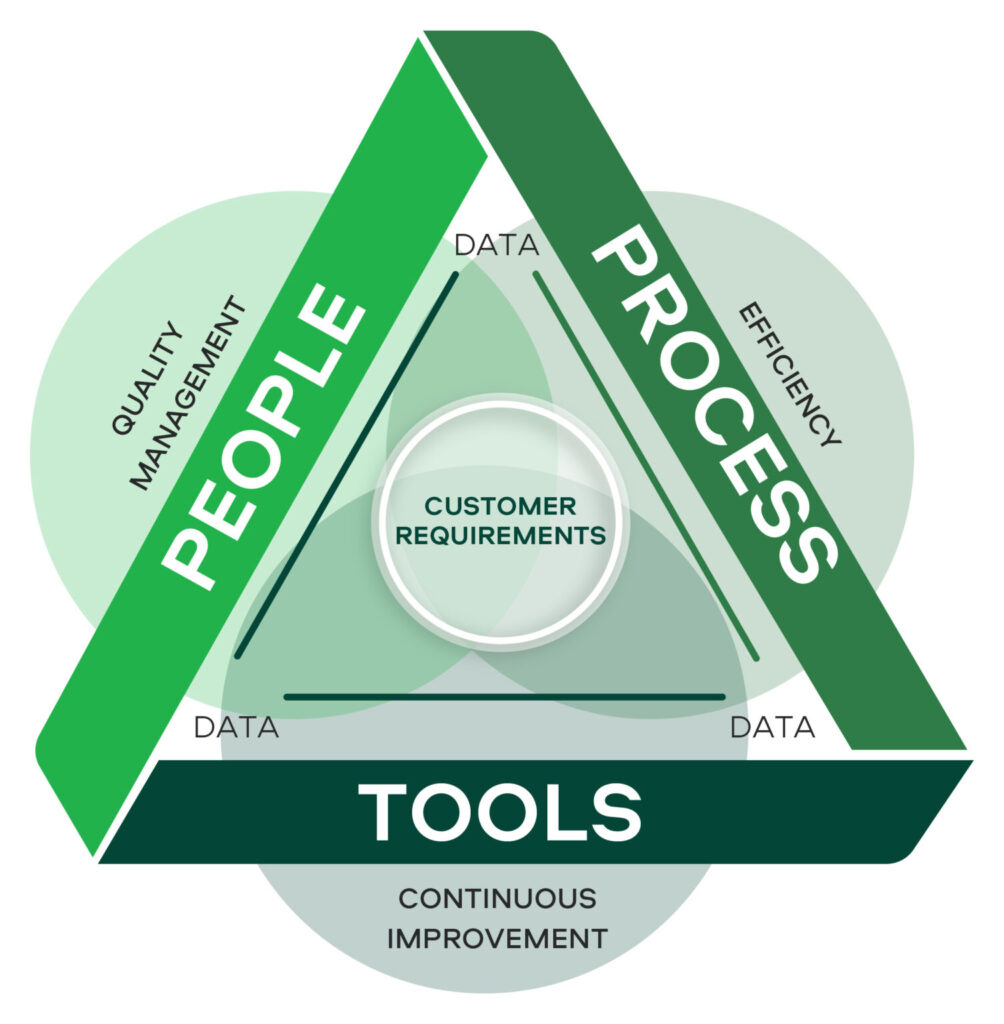
Operational excellence is not achieved in isolation; it demands seamless integration of three fundamental components—processes, people, and tools—all strategically aligned around customer centricity.
Processes alone are not sufficient— PEOPLE remain the driving force behind operational success. A high-performing organization relies on employees who are fully aligned with
customer needs and empowered to execute value-adding activities. It is essential that employees clearly understand their roles in delivering customer-centric outcomes, with
optimized decision paths, efficient scheduling, and the elimination of non-value-adding activities.
To reinforce this, clear authority structures must be in place to enable efficient decision-
making, minimize response times, and enhance process execution. Maintaining excellence also requires continuous performance measurement, using critical metrics such as cycle time, first-pass yield (FPY), rework rates, and throughput efficiency.
Achieving operational excellence requires a structured approach to streamlining workflows,
optimizing operations, and ensuring efficient resource utilization. The continuous evaluation and refinement of PROCESSES drive cost reduction, waste elimination, and enhanced agility, enabling organizations to meet customer demands with speed and precision. Mastery of processes is the foundation for efficiency, responsiveness, and scalability, ensuring that every operational improvement directly contributes to business performance..
Effective measurement and data analytics TOOLS are essential for tracking progress, evaluating performance, and driving continuous improvement. By leveraging these tools, organizations can make data-driven decisions that enhance operational efficiency, uphold quality standards, and foster innovation.
A key component of process enhancement lies in the implementation of continuous monitoring and control mechanisms, such as control plans, performance dashboards, and systematic audits. These tools provide real-time visibility into operations, ensuring that improvements are sustained by identifying process variations, measuring critical metrics (CTQ – Critical to Quality, CTC – Critical to Cost, CTS – Critical to Satisfaction), and proactively addressing inefficiencies.