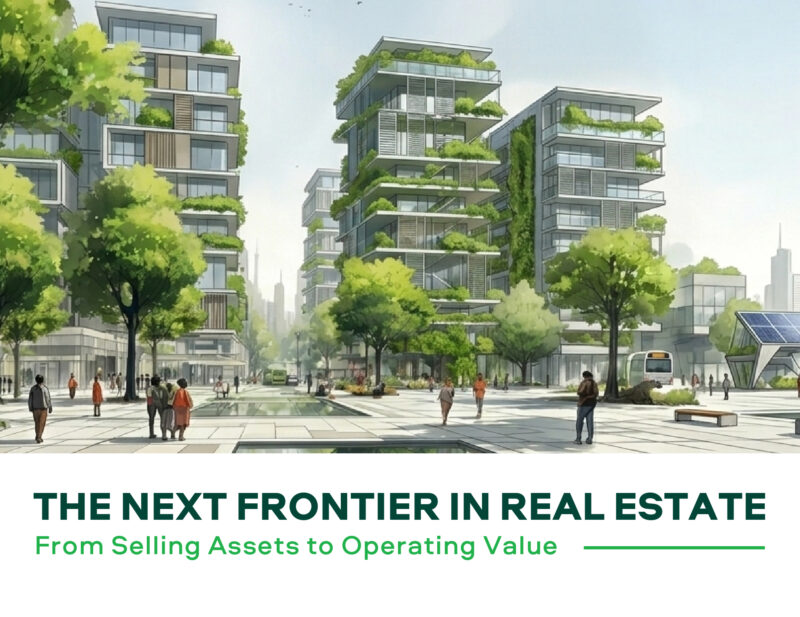
The Next Frontier in Real Estate | From Selling Assets to Operating Value
Real Estate value creation has traditionally followed a well-defined sequence: securing strategically located land, designing products aligned with market demand, executing construction efficiently, and monetizing developments through strong sales absorption. This development-centric model remains commercially effective and continues to support expansion across emerging and transitional markets.
However, the operating landscape is evolving. As projects increasingly take the form of branded communities, mixed-use masterplans, and managed residential environments, the lifecycle of real estate no longer ends at handover. Instead, it extends into the daily experience of residents—shaped by maintenance quality, responsiveness to service requests, communication transparency, and the consistency of community operations. These operational dimensions increasingly influence pricing resilience, reputation, and long-term asset performance.
Across the GCC and wider MENA region, the maturity of customer-centric real estate operations varies significantly between markets. In some markets—most notably Dubai—community management and resident experience have already been institutionalized as core components of the real estate operating model. Professional community management platforms, structured service and complaint management processes, and integrated digital resident applications have become standard features across many residential developments in the emirate.
In other parts of the region—particularly in markets where the development cycle has historically prioritized rapid supply expansion, such as Saudi Arabia—developers have significantly strengthened their capabilities in land strategy, design, construction management, and commercial execution. Yet the post-handover operating model is still evolving, with growing attention being directed toward the operational phase that follows delivery, where resident experience ultimately determines whether trust in the developer and the long-term strength of the brand is reinforced or gradually eroded over time.
1. Where Developers Continue to Excel: Core Drivers of Real Estate Value
Land Acquisition: From Intuition to Data-Driven Strategy
Strategic land acquisition remains one of the strongest capabilities of real estate developers, but what was once largely driven by intuition and broker networks has increasingly evolved into a data-driven discipline. The Middle East’s geospatial analytics market is estimated at approximately USD 5.37 billion in 2026 and projected to reach nearly USD 7.9 billion by 2031, reflecting growing reliance on spatial analytics, smart city planning tools, and digital infrastructure mapping. By integrating these inputs early in the planning process, developers can better anticipate future demand rather than simply responding to current market activity. Some regional developers have already institutionalized more structured approaches to land acquisition and product positioning. In Dubai, Meteora Developers integrates demographic analytics, transaction data, and economic indicators into its site-selection strategy. The company has concentrated several recent residential projects within the Jumeirah Village Circle (JVC) masterplan, one of Dubai’s fastest-growing residential districts, characterized by strong investor demand and expanding community infrastructure. This targeted positioning has supported solid sales performance across projects in this community, including East Crest and 7 Park Central.
b. Design & Construction: Institutionalized Design and Construction Execution
Another area of sustained strength lies in design governance and construction execution. Technologies such as Building Information Modeling (BIM), digital coordination platforms, and integrated project delivery frameworks are now embedded within mainstream development workflows. The GCC BIM market was valued at roughly USD 9.4 billion in 2025, reflecting strong infrastructure pipelines and large-scale urban development programs. Regulation is also accelerating adoption. In Saudi Arabia, the Saudi Contractors Authority has mandated BIM use for government projects, including major developments such as NEOM, The Red Sea Project, and Diriyah Gate. In many cases, BIM is now used beyond 3D modeling—integrating 4D scheduling and 5D cost planning to improve coordination and reduce construction conflicts.
C. Sales: Sales Velocity as the Primary Commercial Driver
Commercial execution remains another defining edge among regional developers. Many
organizations are structured around revenue generation, supported by strong capabilities in:
- Lead generation and digital marketing
- Pre-sales campaigns
- CRM-driven funnel management
- Transaction closure and booking management
A prominent example is Emaar Properties, which recorded ~USD 22 billion in property sales in 2024, representing a 40% year-on-year increase.
Talaat Moustafa Group (TMG), one of the largest real estate developers in Egypt and an expanding player in Saudi Arabia, recorded EGP 211 billion in contractual real estate sales during the first half of 2025, representing a 59% year-on-year increase EGP, and a total of 382 billion in real estate sales in 2025. Strong demand driven by flagship Egyptian developments such as Madinaty and SouthMed, alongside its regional expansion into Saudi Arabia through the Banan project in Riyadh, which generated approximately SAR 7.2 billion in cumulative sales by the end of 2025.
This emphasis on sales velocity is understandable in markets driven by strong investor demand and active off-plan activity. However, it can also lead to structural imbalances. When organizational incentives are heavily weighted toward closing deals, comparatively less attention may be given to nurturing and maintaining the customer relationship after the sale.
As residential developments increasingly operate as master-planned, gated and professionally managed communities, the strategic question shifts from how quickly units can be sold to how consistently value can be sustained once residents move in.