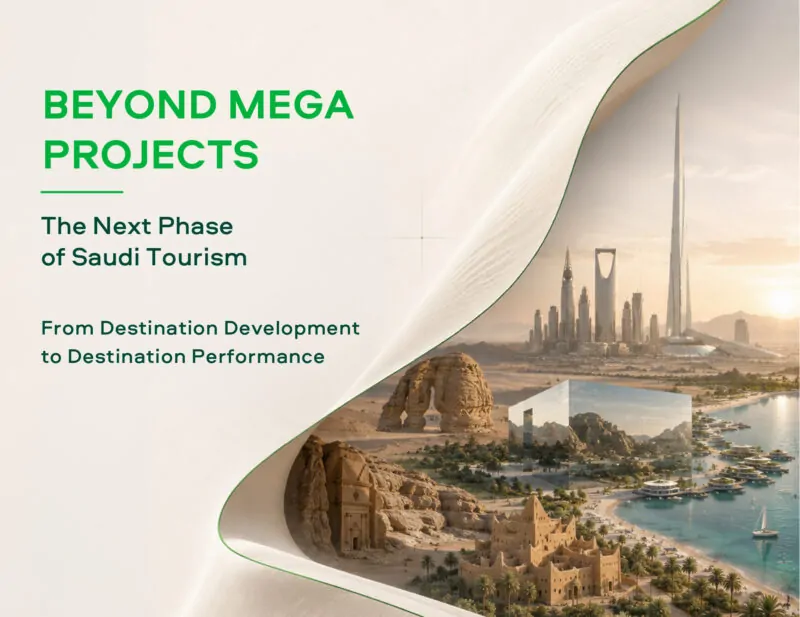
Beyond Mega Projects | The Next Phase of Saudi Tourism
Saudi Arabia has moved beyond establishing tourism as an emerging sector and is now managing it as a significant component of the national economy. In 2025, the Kingdom recorded 123 million domestic and inbound tourists, generating SAR 304 billion in total spending. This momentum has supported a substantial increase in ambition, with the national target rising from 100 million to 150 million annual visits by 2030.
The composition of this growth is as consequential as its scale.
Saudi tourism is therefore being driven by two complementary engines: domestic demand that supports frequency and year-round activity, and inbound demand that delivers higher spending per visitor and international revenue.
The shift from development to operation is already visible in the hospitality market. By the fourth quarter of 2025, licensed accommodation had increased by 34.2% year on year to 5,937 facilities. However, over the same period, hotel occupancy and average daily rates had declined, and the average stay reached 3.8 nights. These figures do not point to a failure of expansion, rather, they reveal the economics of the next phase. As supply grows, returns will depend increasingly on how effectively capacity is filled, priced, programmed, and connected to spending beyond accommodation.
Saudi Arabia’s next tourism advantage will therefore come from converting investment into sustained destination performance. Project delivery and launch visibility will remain important, but long-term value will be determined by whether destinations can maintain demand, refresh their proposition, operate reliably, and distribute tourism benefits across businesses, workers, and communities.
I. Saudi Tourism at an Operating Inflection Point
A. From Visitor Volume to Demand Value
Saudi tourism cannot be managed as a single, uniform market. Religious travel accounted for 48.3% of inbound tourists in 2025, followed by leisure at 24.1%, visits to friends and relatives at 14.9%, and business travel at 7.7%.
Each segment places different demands on the destination
- Pilgrims: Require reliable transport, rapid accommodation turnover, multilingual guidance, clear wayfinding, and high-capacity service delivery.
- International leisure visitors: Are more likely to seek connected itineraries, cultural interpretation, evening activity, and reasons to travel beyond a flagship attraction.
- Domestic travelers: May respond more strongly to weekend packages, familyoriented products, seasonal events, and experiences designed for repeat visitation.
National targets establish the direction of growth while destination-level choices determine whether that growth becomes commercially productive and operationally manageable. A heritage site may prioritize longer stays, guided interpretation, and controlled visitor flows. An urban entertainment district may focus on visit frequency, repeat attendance, and evening spending. A coastal resort may depend more heavily on occupancy, length of stay, and ancillary revenue.
B. From Capacity Expansion to Productive Utilization
During the development phase, progress is visible in the number of hotels, attractions, transport links, and investment commitments delivered. Once those assets begin operating, the strategic question changes from how much capacity has been created to how productively that capacity is being used.
These movements reflect differences in seasonality, events, regional demand, and visitor composition, while demonstrating why annual arrival figures alone offer only a partial view of destination performance.
The next operating discipline is demand orchestration: aligning visitor segments, airline and rail schedules, weather patterns, school and religious holidays, event calendars, accommodation inventory, attraction capacity, and pricing within one destination plan. This allows operators to reinforce weaker periods, protect service quality during peaks, and coordinate destinations rather than have them compete for the same visitors, operators, and transport capacity at the same time.
C. From Standalone Destinations to an Integrated Tourism Portfolio
Saudi Arabia is developing a broad tourism portfolio spanning religious travel, urban entertainment, heritage, archaeology, coastal resorts, nature, wellness, sport, business events, and domestic leisure.
AlUla, Diriyah, the Red Sea coast, Riyadh’s entertainment offers, and the pilgrimage journey require distinct identities, target markets, and operating models.
Distinctiveness, however, should not produce fragmentation. A visitor drawn to one destination should be able to discover, book, and reach complementary experiences elsewhere in the Kingdom. Coordinated event calendars, integrated transport links, travel-trade partnerships, shared visitor information, and joint packages can turn individual projects into multi-destination journeys that increase both trip duration and visitor value.
A portfolio approach also reduces unnecessary competition for the same visitor segments, dates, airline capacity, and operating partners. The objective is not for every destination to offer everything, but for each to occupy a clearly defined and complementary position within the national tourism system.