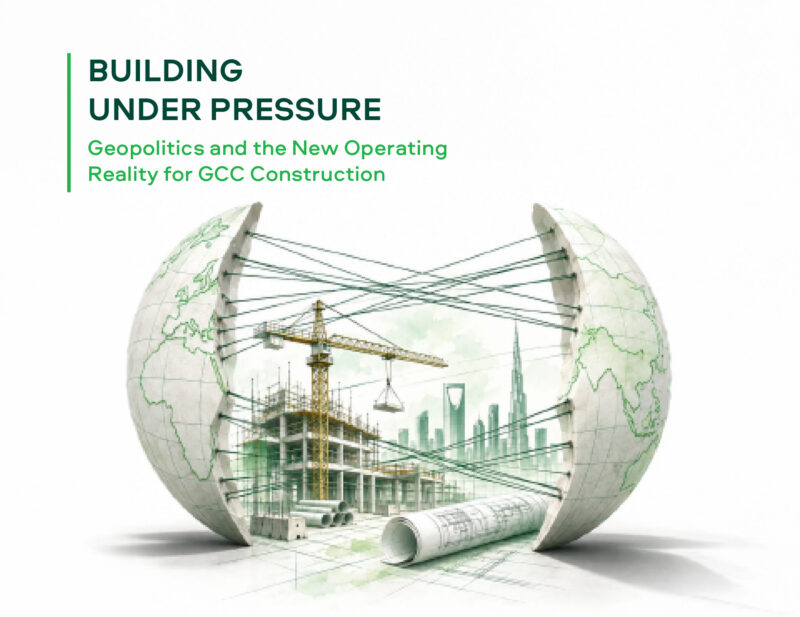
Building Under Pressure | Geopolitics and the New Operating Reality for GCC Construction
The construction industry across the GCC remains one of the region’s most important engines of economic transformation. It supports the infrastructure, urban development, tourism, logistics, industrial, energy, and digital assets required to move national economies beyond hydrocarbon dependence. The sector’s scale reflects this role: the GCC construction market is estimated at approximately USD 350.79 billion in 2026 and is projected to reach around USD 454.12 billion by 2031, supported by infrastructure investment, housing demand, urban expansion, and national diversification programs.
This momentum is anchored in long-term national strategies. In Saudi Arabia, Vision 2030 continues to shape construction demand through investment in tourism, housing, industry, logistics, and digital infrastructure, while PIF’s 2026-2030 strategy places greater emphasis on financial returns, investment efficiency, and private-sector participation. In the UAE, long-term urban planning, transport investment, logistics infrastructure, and digital economy ambitions continue to sustain construction demand across both public and private sectors.
The GCC is navigating an estimated USD 3.4 trillion project pipeline, placing the sector at the center of the region’s economic execution agenda. This means construction is increasingly becoming the mechanism through which governments translate diversification strategies into operational assets—from tourism destinations and industrial zones to transport corridors, utilities, energy systems, and smart cities.
Yet this scale is being tested by a very volatile global environment, and the 2026 regional conflicts have made that exposure more immediate, affecting energy flows, maritime security, business confidence, and project-market activity across the Gulf. During the initial Iran-Israel escalation, the conflict disrupted shipping through the Strait of Hormuz, pushed oil prices above USD 125 per barrel, and contributed to a sharp fall in OPEC+ crude production, which declined by 7.7 million barrels per day in March 2026 compared with February. By October, Gulf oil exports had partially recovered, although renewed attacks on shipping and energy infrastructure threatened further gains.
The sector’s main challenge is no longer limited to traditional delivery risks such as cost overruns, contractor performance, labor shortages, or delayed approvals. Construction activity in the GCC is now exposed to external shocks that sit beyond the direct control of project owners:
- Disruption in maritime trade routes
- Volatility in oil and gas markets
- Fluctuations in industrial materials
- Tighter financing conditions
- Shifting investor sentiment
Recent market performance is already starting to reflect this complex operating reality. GCC contract awards reached USD 204.1 billion in the first nine months of 2026, up 2.5% year on year. However, third-quarter awards declined 37.2% to USD 47.4 billion. Saudi Arabia’s nine-month awards totaled USD 73.4 billion, compared with USD 79.5 billion a year earlier. This does not suggest that the region’s construction ambition has disappeared, but it highlights a widening gap between the strength of the long-term pipeline and the more difficult realities of execution, financing, prioritization, and delivery sequencing.
The sector is therefore entering a new phase, with demand remaining structurally strong, but delivery conditions becoming more exposed, as GCC construction depends on imported materials, international contractors, global financing flows, energy-intensive production processes, and maritime trade routes.
As a result, local project outcomes are increasingly shaped by global systems, where disruptions in shipping, energy, commodities, or capital markets can quickly translate into higher costs, delayed materials, revised budgets, and slower project awards.
I. How Geopolitical Risk Translates into Construction Risk
Geopolitical risk affects construction through a series of connected channels that gradually appear in procurement plans, material prices, financing assumptions, contractual negotiations, and project timelines. This is particularly relevant for the GCC because a lot of projects are large in scale, multi-year, highly material-intensive, and dependent on global suppliers, imported equipment, and international contractor ecosystems.
A. Trade Route Disruption and Supply Chain Pressure
One of the clearest transmission channels is maritime trade. Shipping through the Red Sea and Suez Canal is recovering, but a return to normal operations remains uncertain. In September 2026, container ship traffic through the Suez Canal reached 2.19 million twenty-foot equivalent units (TEU), up 40% from August but still far below the 5.9 million TEU recorded in September 2023. Carriers are gradually restoring selected services, with some voyages remaining subject to security reviews and naval protection. For GCC construction, this partial recovery means delivery schedules remain exposed to changes in shipping routes and transit times.
In the GCC, many projects depend on imported steel products, mechanical and electrical systems, elevators, cooling systems, specialized machinery, and technical equipment. These items are often ordered around tight construction schedules, where one delayed component can affect subcontractor mobilization, installation sequencing, testing, commissioning, and handover dates.
The impact is felt across the project lifecycle:
- Procurement teams must secure alternative suppliers earlier and manage longer lead times
- Contractors may hold higher inventory levels, increasing storage and working capital costs
- Project managers face greater uncertainty in sequencing site activities
- Developers need to revise milestones when critical imported systems arrive later than planned
- Freight, insurance, and logistics costs can move faster than contractual allowances
This means that construction timelines in the GCC are increasingly shaped by the stability of shipping corridors, the availability of vessel capacity, the resilience of suppliers, and the ability of project teams to adapt procurement strategies before disruptions reach the site.
B. Energy, Commodity, and Material Price Volatility
Energy markets form another critical transmission channel. Construction relies heavily on energy-intensive materials such as cement, steel, aluminum, glass, copper, and petrochemical-based products, while also depending on fuel for transportation, equipment, and site operations. With the regional conflicts pushing oil prices to record highs, the pressure moves beyond oil markets into diesel, freight, insurance, power-intensive production, and the embedded energy cost of key building materials.
This creates an important GCC paradox. Higher oil prices may strengthen fiscal revenues in hydrocarbon-exporting economies, supporting public spending capacity. However, they can also raise the cost base of construction delivery because many project inputs are globally priced, imported, or linked to international production and logistics costs. In practice, the same geopolitical environment that may support government revenue can increase material, transport, and equipment costs for projects.
The conflicts are also affecting the materials landscape more directly. In April 2026, Iran temporarily suspended exports of steel slabs and sheets until the end of May 2026 after conflict-related damage took around 25% to 30% of the country’s steel production capacity offline, equivalent to roughly 10 million tons.
Aluminum is another area of concern for Gulf contractors. With production curtailed at facilities such as Taweelah, Alba, and Qatalum, and with Hormuz shipping constrained, contractors have faced a shift away from regional premium assumptions toward LME-plus-import-premium pricing for a larger share of their aluminum requirements through 2026.
Material volatility is especially important for the GCC because large-scale developments require significant volumes, which means that even modest price movements can translate into substantial absolute cost increases across giga-projects:
- Feasibility studies become less reliable when prepared under outdated cost assumptions
- Contractors face margin compression under fixed-price or lump-sum contracts
- Suppliers gain stronger negotiating power when quotations shorten or availability tightens
- Project controls teams need frequent cost reforecasting, not only annual budget reviews
The deeper shift is that procurement is becoming more strategic. The question is no longer which supplier offers the lowest bid, but which supplier can provide reliable delivery, acceptable price visibility, and enough flexibility under unstable global conditions.
C. Contractual, Commercial, and Financing Pressure
As logistics and material risks intensify, they eventually appear in contracts. Fixed-price contracting becomes harder to sustain when contractors are expected to absorb cost movements that were not foreseeable at the time of award. This increases the importance of escalation clauses, hardship provisions, change orders, early-warning mechanisms, and disciplined claims management.
This is particularly relevant in the GCC because projects often involve long delivery horizons, complex contractor ecosystems, imported materials, and multiple tiers of subcontractors. When freight costs rise, lead times extend, or material prices move sharply, the question becomes who carries the burden: the owner, the main contractor, the subcontractor, the supplier, or the insurer. Poorly structured contracts can push stress down the supply chain until it appears as contractor distress, disputes, delayed delivery, or renegotiation.
Financing conditions add another layer of pressure. Geopolitical uncertainty can influence borrowing costs, risk premiums, lender appetite, and investor confidence. Even when government-backed projects remain resilient, private or mixed-financing projects become more sensitive to feasibility, demand assumptions, risk allocation, and cost-control credibility. In this environment, capital does not disappear, but it becomes more selective.
This creates a more disciplined investment environment:
- Government-backed projects remain more resilient when linked to national priorities
- Private developments face stronger scrutiny, especially where demand is uncertain
- Phased development becomes more attractive because it limits exposure over time
- Projects with weak cost control or high import dependency become harder to finance
- Lenders and investors place greater emphasis on readiness, governance, and risk allocation
Geopolitical risk therefore affects projects before and after construction begins. It shapes which projects are approved, how they are financed, how quickly they are awarded, how contracts are structured, and how much contingency is built into delivery plans.
D. From Isolated Project Risks to Systemic Exposure
The defining feature of the current environment is that these risks reinforce one another. A shipping disruption can increase freight costs, delay imported materials, raise storage requirements, affect subcontractor sequencing, trigger claims, and weaken confidence in delivery timelines. Energy volatility can increase material production costs, affect inflation, influence government fiscal assumptions, and reshape financing conditions.
The risk environment is therefore becoming systemic rather than isolated:
- Logistics risks affect delivery timelines
- Energy risks affect cost structures
- Commodity risks affect procurement and budgets
- Contractual risks affect margins and claims
- Financing risks affect project prioritization and execution pace
The strongest construction players in the GCC will not only be those that manage site execution well. They will be those that build resilience into procurement, contracts, financing, scheduling, governance, and decision-making from the earliest stages of project planning.
II. The GCC Construction Paradox – Highly Exposed, but Structurally Resilient
The GCC construction sector is shaped by a structural paradox. It is highly exposed to geopolitical risk because it is large, globally connected, dependent on imported inputs, and located near critical trade and energy corridors. At the same time, it is structurally resilient because demand is anchored in national strategies, sovereign capital, government-backed infrastructure programs, and long-term diversification agendas.
A. Scale and Policy-Led Demand Increase Exposure
Construction demand in the GCC is not purely market-led, but closely tied to national transformation agendas and sovereign investment priorities. Saudi Arabia illustrates how changes in those priorities can reshape construction demand. The Kingdom is reducing its emphasis on some costly, long-horizon real-estate giga-projects while placing greater weight on industry, logistics, digital infrastructure and investments offering clearer financial returns. This rebalancing began before the 2026 conflict, reflecting project delays, cost pressures and the need for stronger returns. Regional conflict has since added fiscal and security pressures, reinforcing the need for disciplined capital allocation.
While PIF’s 2026-2030 strategy retains urban development and NEOM among its priorities, recent contract decisions demonstrate the changing composition of demand: within NEOM, Webuild’s contract for Trojena’s dams and The Bow was terminated in March 2026, followed by its Connector High-Speed Line contract in May. Meanwhile, Diriyah Company announced USD 727.9 million in construction contracts for hospitality and residential assets on 5 October 2026.
These developments make project prioritization and delivery sequencing more important, as financial pressures and geopolitical risks influence where capital is deployed. Large, multi-year projects are more vulnerable to cumulative cost escalation, imported material delays, financing changes, contractor capacity constraints, and reprioritization. The longer the delivery horizon, the greater the probability that external shocks will occur between design, procurement, construction, and completion.
The scale of GCC construction therefore works in two directions:
What Scale Enables:
- Sustained demand through public commitment and strategic planning
- Large-scale transformation across cities, tourism, logistics, and industry
- Long-term economic repositioning beyond hydrocarbons
- Stronger government-backed project continuity
What Scale Exposes:
- Greater exposure to cost escalation over extended timelines
- Higher dependency on imported materials and specialist contractors
- Greater need for phasing, prioritization, and fiscal discipline
- More complex coordination across public entities, developers, financiers, contractors, and suppliers
The same ambition that makes the GCC one of the world’s most active construction markets also makes delivery more complex when global conditions become unstable.
B. Global Integration and Geographic Position Create Structural Vulnerability
The region benefits from global integration because it gives projects access to international contractors, engineering expertise, specialized equipment, global suppliers, and cross-border capital. However, this also means that disruptions in maritime trade, commodity markets, or international finance can quickly affect local project delivery. More than 80% of global trade is carried by sea, making maritime transport a critical backbone for construction inputs and industrial supply chains.
Geography adds another layer of exposure. The GCC sits close to some of the world’s most sensitive trade and energy corridors. Among them, the Strait of Hormuz remains a central energy chokepoint, with oil flows through the strait averaging 21.6 million barrels per day in 2025, equivalent to around 20% of global petroleum liquids consumption. Other corridors include Bab El-Mandeb, the Red Sea, and the Suez Canal route which historically carried around 10% of global maritime trade by volume and 22% of containerized trades. Disruption in these corridors, as explored above, can affect shipping, insurance, fuel costs, and broader commodity markets. This is why in March 2026, Gulf oil exports across all routes fell by 15.8 million barrels per day month-on-month to 8.7 million barrels per day, while exports transiting Hormuz averaged only 2.3 million barrels per day.
For Saudi Arabia, the existence of the East-West pipeline gives the Kingdom an important buffer by allowing crude to move from the Gulf-facing east to Yanbu on the Red Sea. The pipeline was restored to its full 7 million barrels per day capacity in April 2026 after attacks linked to the Iran-Israel conflict, but suffered further attacks in the last few months, temporarily disrupting flows. These incidents showed that alternative infrastructure can itself become part of the risk landscape. Rerouting away from Hormuz reduces one concentration risk, but it increases the strategic importance of Red Sea ports, western logistics corridors, pipeline security, and industrial resilience around Yanbu and the western coast.
C. Government-Led Demand Provides Stability, but Not Immunity
Government-led demand remains one of the GCC’s strongest stabilizers. Unlike construction markets driven mainly by private real estate cycles, many GCC projects are linked to infrastructure priorities, sovereign investment strategies, national housing programs, industrial development, and long-term economic diversification.
However, the decline in GCC contract awards in Q3 2026 shows that even policy-backed pipelines can slow when project spending is rephased, execution capacity is reassessed, or cost and financing conditions become more difficult. The sector remains fundamentally active, but the pace of execution becomes more selective.
Government backing therefore reduces the likelihood of broad demand collapse, but it does not eliminate delivery risk. Projects may continue, but they can be phased, redesigned, reprioritized, delayed, or restructured to reflect fiscal conditions, market capacity, supply chain pressure, and execution readiness.