1.1. Strategic Repositioning of GCC Economies
From forward-leaning discussions on capital deployment to geopolitical realignments and digital transformation, the forum reflected a deeper shift underway across the region. The GCC is stepping into a role that transcends its traditional identity as an energy supplier. It is now emerging as a laboratory for institutional reform, a testing ground for cutting-edge technology, and a strategic interlocutor in global diplomacy. This strategic pivot is not merely a response to the volatility of global commodity markets, but a proactive stance designed to future-proof their economies against external shocks, climate transitions, and evolving global demand patterns. It is being operationalized through interlinked approaches:
- Investing in new industries by building capabilities in manufacturing, pharmaceuticals, chemicals, and renewable technologies.
- Reforming regulatory environments to ease foreign ownership restrictions, offer investor incentives, and support public-private partnerships.
- Strengthening global market ties through sovereign wealth fund investments, strategic bilateral deals, and participation in global trade corridors.
These institutional shifts have laid the groundwork for economic models defined more by resilience, agility, and scale. The forum underscored that this transition is driven by foresight, pointing to a ten-year planning horizon, centered on Vision 2030 frameworks and cross-sectoral integration, as the backbone of economic stability. This is where Gulf exceptionalism now lies: institutional agility, cross-border cooperation, and long-term planning.
1.2. Qatar’s Diversification Strategy
Translating Global Visibility into Economic Maturity
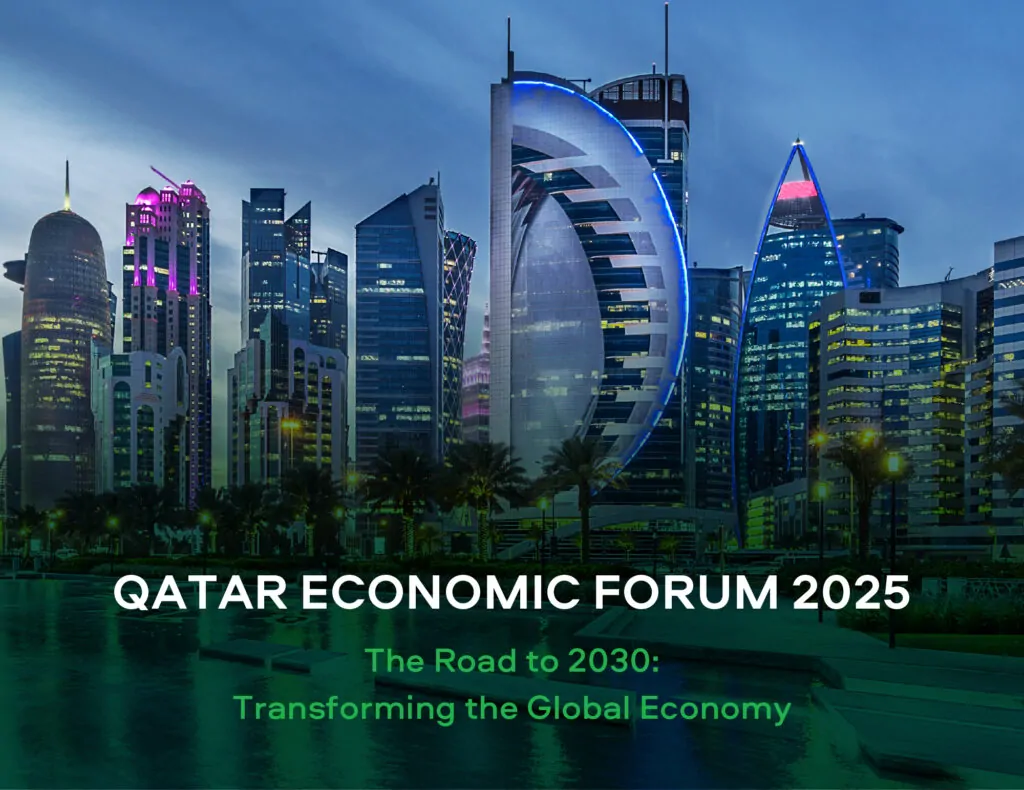
In a compelling metaphor, Qatar’s Prime Minister H.E. Sheikh Mohammed bin Abdulrahman Al-Thani likened the 2022 World Cup to an IPO. He stated, “I have a friend who once told me that the World Cup was like an IPO for Qatar. I believe this was… a very successful IPO”. The tournament catalyzed visibility, and the post-event period has been leveraged as an inflection point for deep economic recalibration. The World Cup functioned as a geopolitical showcase—inviting global attention to Qatar’s institutional readiness, infrastructure capabilities, and investment environment.
Qatar’s $1 billion investment incentive program, launched by Invest Qatar, reflects this strategy. Targeting four strategic sectors—advanced industries, logistics, technology, and financial services—the program offers financial packages covering up to 40% of operational costs, from construction to staffing. The objective is to convert episodic exposure into sustained sectoral competitiveness and catalyze the emergence of globally relevant industrial clusters. It is a mechanism to both attract high-value capital and accelerate the maturation of the country’s economy beyond hydrocarbons.
Strategic Sectors Driving Qatar’s Future
Advanced Industries
- Focus: Focusing on high-value, technology-intensive sectors such as pharmaceuticals, chemicals, automotive, and electronics.
- Role in Economic Transition: Driving non-oil exports and value-added manufacturing in critical verticals.
Logistics & Infrastructure
- Focus: Enhancing infrastructure, automation, and advanced logistics services to position the region as a global logistics hub.
- Role in Economic Transition: Enhancing connectivity and establishing GCC as a key node in global trade.
Technology & Digital Economy
- Focus: Investing in cybersecurity, cloud computing, artificial intelligence, and data-driven innovation to bolster the digital economy.
- Role in Economic Transition: Enabling smart services, AI integration, and national competitiveness in emerging tech.
Financial Services
- Focus: Advancing fintech, insurance, asset and wealth management, particularly in financial districts like Lusail.
- Role in Economic Transition: Building robust ecosystems for fintech, capital markets, and wealth management.
Qatar’s real estate sector was also addressed during the panel discussion titled “Global Real Estate Horizons: Navigating Growth & Demand.” H.E. Abdullah bin Hamad bin Abdullah Al-Attiyah, Minister of Municipality and Chairman of Qatari Diar, emphasized the sector’s resilience amid external challenges. He cited Qatar’s safety, cultural coherence, and targeted infrastructure developments—such as the Land of Legends tourism and entertainment complex in Simaisma— as primary drivers of continued demand.
In energy, QatarEnergy CEO Saad Sherida Al-Kaabi emphasized the need for sustained LNG investment at price thresholds of $70–$80 per barrel—reaffirming the state’s strategy of reinforcing core sectors while scaling new ones. These investments ensure Qatar’s leadership in global energy security while funding its diversification efforts.