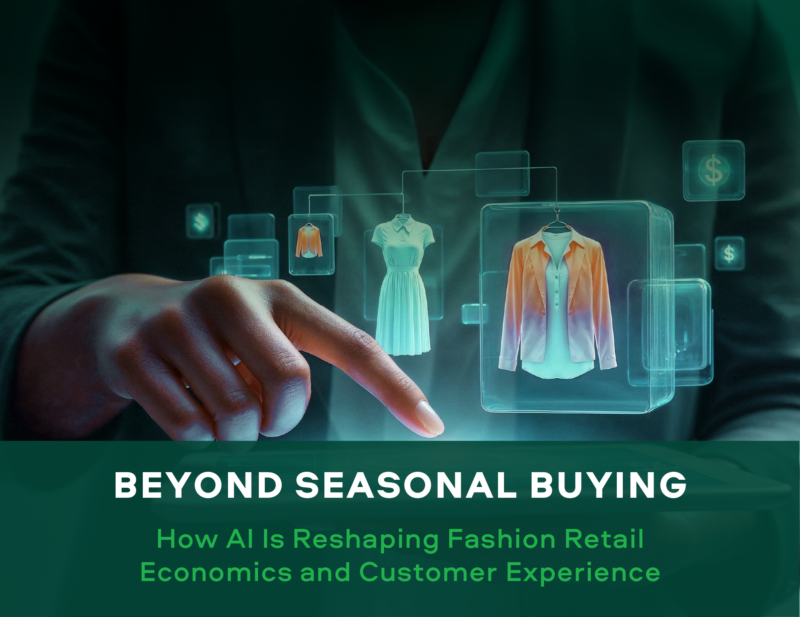
Beyond Seasonal Buying | How AI Is Reshaping Fashion Retail Economics and Customer Experience
Fashion retail has long operated around seasonal planning cycles, where collections are designed, produced, allocated, and marketed months before customers begin shopping. This model provides creative direction, commercial discipline, and operational rhythm, but it also exposes retailers to a recurring challenge: capital is committed before demand is fully visible through search behavior, product views, store traffic, purchases, returns, reviews, and social signals. As trend cycles accelerate and customer journeys fragment across channels, the traditional seasonal model is becoming less sufficient on its own and can translate into excess stock, stockouts, early markdowns that have a negative impact on overall price realization value, and slower cash recovery.
The global cost of this mismatch according to IHL Group remains substantial, with global retail inventory distortion, covering both overstock and out-of-stocks, estimated at around USD 1.73 trillion annually, despite USD 172 billion in improvements over the previous year.
AI is gaining relevance in fashion retail because it allows retailers to work with demand signals at a higher level of precision and at a faster decision rhythm. Its role is strongest when it supports decisions across forecasting, allocation, replenishment, personalization, pricing, marketing, product visibility and customer experience. The value of AI should therefore be measured through commercial outcomes:
In this context, AI becomes a lever for improving inventory discipline, customer relevance, and retail profitability. It gives fashion retailers a way to make planning more responsive without replacing brand-led judgment.
I. Smarter Demand Planning: Bringing Precision to the Fashion Retail Operating Model
A. From Seasonal Planning to Demand-Led Retail Execution
Seasonal planning remains central to fashion retail because collections still require buying budgets, supplier timelines, price architecture, launch calendars, store allocation, and marketing plans before they reach the customer. The commercial challenge appears when too much capital is committed before the retailer has enough visibility on which products will gain momentum, which sizes will move faster, which channels will convert better, and which items may create return or markdown risk.
AI can strengthen this cycle by continuously updating demand assumptions using sales performance, stock movement, store-level demand, inventory availability, and replenishment needs, allowing retailers to adjust planning decisions as new signals emerge rather than waiting for post-season reviews.
FLO, a footwear retailer, used AI-powered demand forecasting, allocation, and replenishment to improve stock decisions across its retail network. The system used a financial optimization engine to evaluate trade-offs between potential lost sales and inventory holding costs before recommending allocation and restocking moves that would maximize revenue. When demand shifted unexpectedly, the system flagged stores running low and identified locations with excess stock, allowing FLO to rebalance inventory across the network instead of treating each store’s stock position in isolation. The reported impact included a 12% reduction in lost sales and a 4.7% increase in revenue, showing how AI can influence buying depth, store distribution, replenishment, and stock productivity in measurable ways.
B. Assortment Intelligence and Earlier Trend Detection
Demand sensing becomes most valuable when it informs decisions before further capital is committed. In fashion, this means using customer preference data, sales behavior, product attributes, fit feedback, return patterns, and early trend signals to decide what should be restocked, refined, co-developed, reduced, or tested through smaller runs. These signals are most useful when they influence assortment choices and product decisions, rather than only improving how customers search for existing products.
Stitch Fix illustrates how demand intelligence can move closer to merchandising and product development by combining algorithmic recommendations with direct client feedback, including what customers keep, return, request, or reject. Its recommendation engine can simulate future demand up to 12 months ahead, helping merchants identify which styles to restock, add, or co-develop with partner brands. The system also helps distinguish products that may expand the customer base from products that mainly serve existing clients, making the insight more useful for assortment planning, inventory decisions, and partner collaboration.
This type of demand intelligence is especially relevant in fashion because product performance is rarely explained by sales volume alone. A product may:
AI becomes valuable when it helps separate true product weakness from issues that can be corrected through fit, sizing, content, allocation, or customer targeting.
Moreover, AI is becoming more relevant at the earlier trend-intelligence stage, where retailers try to identify emerging aesthetics, colors, silhouettes, and customer preferences before collections are fully developed. LPP, the owner of Reserved and Sinsay, uses AI to predict fashion trends through social media analysis, shortening its design cycle from 6-12 months to around 6-12 weeks.
This adds another layer to assortment intelligence. Beyond deciding what to restock or replenish, AI can help retailers identify what should enter the assortment in the first place. For fashion retailers, this is particularly useful when the objective is to respond to fast-moving style signals without turning every trend into a large production commitment.