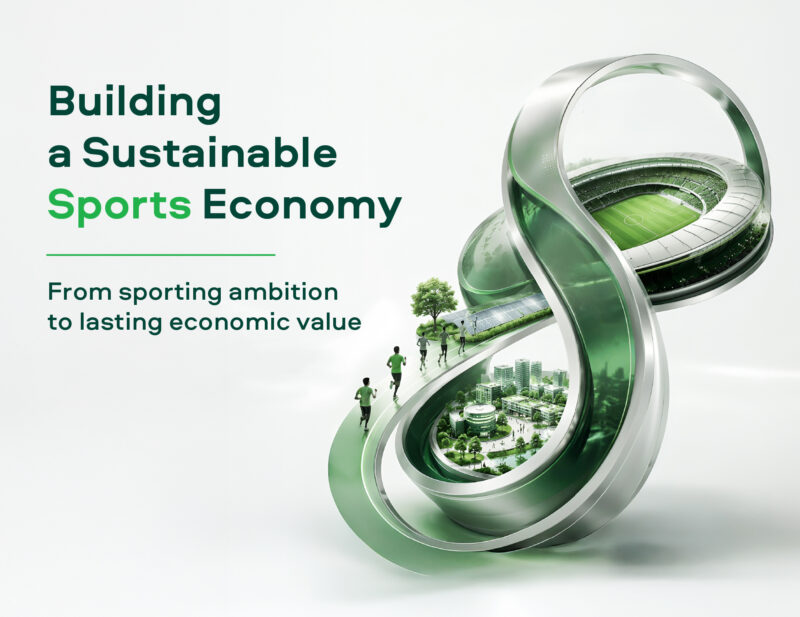
Building a Sustainable Sports Economy | From sporting ambition to lasting economic value
Global sports revenues continue to rise, yet commercial growth has not consistently translated into stronger institutions. European top-division football club revenues are expected to exceed €30 billion in 2025, supported by continued commercial growth across the continent’s largest clubs: 17 of Europe’s top 25 clubs reported record commercial income. However, rising revenues have been accompanied by significant cost pressures. Non-wage operating costs absorb 36% of club revenue and aggregate pre-tax losses remained close to €1.2 billion in 2024 with only a small majority—53%—of clubs across Europe’s 20 largest leagues recording a pre-tax profit. The sector is expanding, but the financial strength of many of its institutions has not kept pace.
The European experience offers a relevant lesson for markets across the MENA region seeking to expand their sports sectors: revenue growth alone does not create institutional resilience. A sustainable sports economy extends beyond professional clubs and elite competition. It also depends on a broad and active participation base that supports demand for facilities, services, talent pathways, and commercial activity.
The broad and active participation base is measured by the rates of physical activity across different age groups and accordingly creating the relevant occupancy for the sports facilities. The engagement of population in sports is critical success factor in employment and growth in the sector. In Saudi Arabia, for example, that base is growing but remains uneven: 59.1% of adults completed at least 150 minutes of physical activity per week in 2025, while only 19% of children and adolescents aged 5–17 achieved at least 60 minutes of daily activity. These figures point to rising engagement alongside significant room for growth across academies, community programs, coaching, fitness services, sports technology, and grassroots competition.
Governments are developing institutional frameworks capable of organizing the sector, defining responsibilities, and creating the conditions for investment, therefore providing the foundations through which this broader market can be strengthened. Whether these frameworks develop into lasting economic value will depend on three closely linked conditions: clear institutional mandates, professionally managed organizations capable of converting investment into performance, and financial models that are able to withstand changes in leadership and market conditions.
I. Defining the Rules of the Sports Economy
A. Governance as Market Infrastructure
Sports governance is often reduced to boards, policies, and compliance, yet its economic role is considerably broader. It establishes who regulates each discipline, licenses participants, manages national teams, operates competitions, controls commercial rights, approves investors, owns intellectual property, and resolves disputes. Where those responsibilities overlap, uncertainty affects everything from sponsorship negotiations and broadcasting agreements to club management and investment decisions.
England provides one model for separating financial oversight from sporting regulation. The Football Governance Act established an Independent Football Regulator for the top five levels of men’s football, with responsibility for financial sustainability, ownership standards, licensing, financial distribution, and fan engagement, while sporting rules remain with the football authorities. The reform followed repeated cases of club distress linked to weak ownership and excessive financial risk.
Germany applies a different safeguard through the Bundesliga’s 50+1 rule. Club members generally retain more than half of the voting rights, allowing private investors to provide capital without securing controlling influence. The model preserves member authority over institutions with deep community roots.
The two systems differ in design, but both address the same underlying tension. Heavy institutional control can slow decision-making and discourage investment, while unrestricted ownership can increase financial risk and weaken the relationship between clubs and their supporters. Effective governance creates room for commercial growth while preserving the relation with mass supporters, competition integrity, and institutional identity.
B. Regional Approaches to Institutional Coordination
Institutional arrangements vary according to the role of government, the autonomy of sporting bodies, the maturity of professional leagues, and the extent of private-sector participation. Across the region, however, reforms are moving in a similar direction: clearer responsibilities, stronger governance, greater organizational autonomy, and a wider role for private investment.
Saudi Arabia’s new Sports Law provides one of the region’s most detailed legal frameworks. It recognizes clubs, leagues, federations, the Saudi Olympic and Paralympic Committee, facilities, academies, institutes, and sports centers as components of an interconnected sector. It also enables clubs and leagues to operate as companies, strengthens governance requirements, and requires the Ministry of Sport to maintain an updated database for investors and other stakeholders.
Within this framework, the Ministry of Sport retains responsibility for the sector’s overall development and regulation. Its remit includes coordination across government, private-sector, non-profit, and sporting stakeholders, participation and professional development, research, technology, and sports medicine, the National Sports Register, company formation, licensing, foreign ownership, and major ownership changes.
The Saudi Olympic and Paralympic Committee occupies a distinct position within the system. As the non-governmental body responsible for the Olympic and Paralympic movement, it represents the Kingdom internationally, leads national delegations, coordinates participation in major games, organizes related competitions, and manages the associated rights.
Individual sports fall under their respective federations, while leagues are primarily responsible for organizing and managing competitions and their commercial activities, and clubs focus on athlete development, sporting programs, community activity, asset management, and revenue generation.
The result is a framework of distinct but interconnected mandates. Its effectiveness depends on transparent procedures, predictable decision-making, clearly defined approval requirements, and workable accountability mechanisms. The law also strengthens internal governance through requirements covering general assemblies, boards, executive functions, director liability, and the rights of voting members.
Qatar organizes its sector priorities through the National Sports Policy. The policy brings participation, governance, financing, facilities, elite performance, partnerships, innovation, and sports medicine within one national framework. By addressing these areas together, it provides a common direction for developing the sector—from community participation and athlete pathways to professional competition and major-event hosting—alongside the institutions, facilities, funding, and capabilities needed to support them.
The UAE’s federal sports law similarly combines institutional development with private-sector participation. It recognizes sports companies, promotes coordination between federal and local institutions, and encourages private investment. Rather than treating commercial development as separate from sporting policy, the framework connects it with governance, community participation, and the performance of sports entities.
Egypt is also strengthening the conditions for private investment in sports entities. Recent amendments have expanded the legal scope for external ownership and potential public listings of sports companies, subject to governance, disclosure, financial-reporting, and shareholder-protection requirements.
These approaches reflect different stages of market development, but they pursue a common objective: an institutional environment that can coordinate public priorities, preserve sporting integrity, strengthen organizational accountability, and create credible opportunities for private capital.