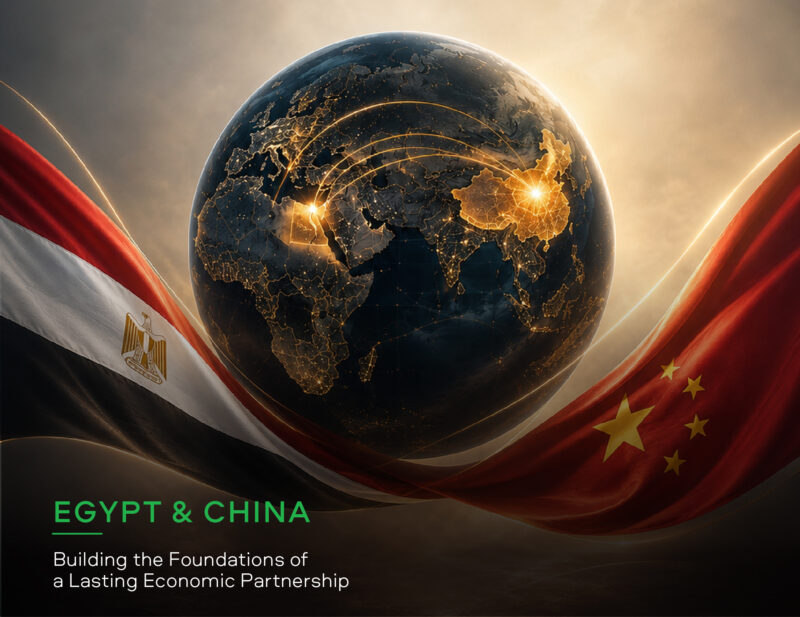
Egypt and China: Building the Foundations of a Lasting Economic Partnership
Egypt’s relationship with China began with a diplomatic decision that placed it at the forefront of Arab and African engagement with the People’s Republic. On May 30, 1956, Egypt became the first country in both regions to establish diplomatic relations with China. The decision followed the 1955 Bandung Conference, where Egyptian and Chinese positions converged in their support for sovereignty, national independence, and opposition to colonialism. Their partnership preceded the establishment of the Non-Aligned Movement in 1961, while reflecting several of the principles that informed it.
These diplomatic foundations later acquired a more structured economic direction through the Comprehensive Strategic Partnership established in 2014 and its implementation program, linking Chinese commercial capabilities with Egypt’s priorities for economic development and integration into international markets. Egypt offers Chinese enterprises access to a substantial domestic market, connections to African and Arab markets, and a location suited for international production and distribution. Its regional diplomatic influence adds a further dimension to the relationship. For Egypt, cooperation with China supports efforts to attract industrial investment, develop infrastructure, and diversify international partnerships. President Xi Jinping’s state visit on the 1st of September 2026, coinciding with the seventieth anniversary of diplomatic relations, extended this agenda through renewed commitments to deepen industrial, technological, and financial cooperation. The economic substance of the partnership is now evident across operating factories, major infrastructure projects, technical cooperation, and access to additional financing channels.
1. Establishing the Industrial Foundations
A. Creating the Conditions for Long-Term Investment
TEDA: Tianjin’s Economic-Technological Development Area (TEDA)’s involvement in Egypt dates to 1998, when the two countries signed a letter of intent concerning the development of the Northwest Gulf of Suez Economic Zone. Drawing on its experience, TEDA was selected to support the initiative. Construction of the Egyptian cooperation-zone project began in 2008, with an initial development area of 1.34 km².
The development approach brought industrial land, infrastructure, and investor services together within a coordinated platform. Construction proceeded in phases, allowing partners to establish initial facilities, attract enterprises, and build the basis for further expansion. Applying this approach in Egypt required adapting the Tianjin experience to Egyptian circumstances, with adjustments to the pace and sequencing of infrastructure expenditure and investment attraction.
TEDA’s early establishment made it an industrial anchor in the wider Suez Canal development program. Its institutional identity remains separate from that of the SCZone (Suez Canal Economic Zone), whose current authority was constituted in August 2015 under Egypt’s special economic-zone framework. SCZone provides the broader institutional setting for industrial and logistics development, while TEDA operates as a dedicated cooperation zone under that framework.
This concentration of activity reflects the development of an industrial location capable of supporting multiple enterprises through shared infrastructure and services, which provides an established base for further industrial cooperation.
B. Turning Initial Investment into Industrial Scale
Jushi Egypt demonstrates how this development model translates into manufacturing activity. Established in January 2012, the company located its fiberglass operations approximately five kilometers from Ain Sokhna port. Its first production line entered full operation in April 2014, followed by additional phases in 2016 and 2017, progressively expanding the capacity of its Egyptian manufacturing base.
The project was designed to serve Egypt alongside other markets including Europe, Turkey, the Middle East, and North Africa, making international distribution part of its commercial rationale from the outset. By 2025, the facility comprised four production lines and exported through SCZone’s ports, connecting production within the zone to international customers. Its development highlights a sequence that is central to the value of industrial cooperation: an initial investment establishes operations, subsequent commitments increase scale, and access to customers sustains the resulting production.
ACUD (Administrative Capital For Urban Development / العاصمة الإدارية للتنمية العمرانية): Chinese corporate participation in Egypt also extends across major infrastructure and urban-development projects, including the Central Business District in the New Administrative Capital, the New Alamein towers, and the light rail transit project. These activities demonstrate the breadth of the development relationship beyond the manufacturing investments. Assessing them separately helps distinguish investment that generates industrial output and infrastructure projects whose value depends on the services and economic activity they enable.
2. The Opportunity and Exposure of a Strategic Location
A. Egypt as a Platform for International Markets
The industrial relationship entered a further stage in January 2016, when Presidents Abdel Fattah El-Sisi and Xi Jinping inaugurated TEDA’s expansion phase and agreed to broaden cooperation under the Belt and Road Initiative. The accompanying 2016-2020 program placed the cooperation zone within a more structured bilateral development agenda.
At the 2019 Belt and Road Forum (BRF), President Abdel Fattah El-Sisi outlined how cooperation under the initiative could support Egypt’s Vision 2030, particularly by improving transport, energy, and information technology infrastructure and promoting industrial development and trade. He presented the Suez Canal development project as a practical expression of this cooperation: an industrial, commercial, and logistics hub where Chinese companies could establish production facilities and export to European, African, and Arab markets. His remarks placed the canal at the center of Egypt’s ambitions to connect domestic industrial development with international trade.
The commercial proposition is built on the interaction between industrial capacity, port connectivity, and access to both domestic and international markets. SCZone strengthens this proposition through integrated infrastructure, logistics services, and customs arrangements intended to facilitate trade. For China, these commercial advantages are reinforced by Egypt’s regional diplomatic influence, giving the relationship significance beyond the performance of individual projects and investments.
Egypt’s trade agreements further complement this position. The EU-Egypt Association Agreement, in force since 2004, established a free-trade area for industrial products, while the Euro-Mediterranean framework sets the rules of origin that determine eligibility for preferential market access. Together, these provisions can strengthen the export proposition and improve competitiveness of eligible Egyptian exports in European markets.
B. Bilateral Trade & Egypt’s Exports
The bilateral trade relationship reveals substantial commercial activity alongside a pronounced imbalance:
- Egyptian exports to China: $840.8 million (Up from $280.5 million in H1 2025, +199.8% year on year).
- Egyptian imports from China: $10.4 billion.
- Egypt’s trade deficit: ~$9.6 billion.
These flows indicate significant Egyptian demand for industrial goods with a more concentrated range of exports.
Two complementary avenues could deepen Egypt’s participation. Expanding the range and value of Egyptian goods & services sold to China would strengthen direct bilateral exports, consistent with the September 2026 commitment to improve trade balance and facilitate access for Egyptian products.
3. From Investment Expansion to Industrial Depth
A. Expanding into Advanced Industries
The September 2026 visit established a further direction for industrial cooperation. President El-Sisi announced agreement to launch the third phase of expansion of the Egyptian-Chinese industrial zone, identifying renewable energy, automotive manufacturing, textiles, and chemical fibers among the targeted sectors. These priorities define an intended program of development whose economic contribution will depend on the implementation and operation of the associated projects.
The ATUM Solar complex, whose groundbreaking took place in December 2025, illustrates the emerging investment pipeline. The announced $210 million project brings together China’s JA Solar with Egyptian, Emirati, and Bahraini partners within TEDA Egypt. Its planned annual capacity comprises 2 GW of solar cells, 2 GW of solar panels, and 1 GWh of energy-storage systems.
The project’s proposed economic contribution extends beyond production capacity, with a design that connects export production with opportunities for domestic sourcing. The complex plans to source Egyptian aluminum and glass, create 850 direct jobs, and allocate solar-cell output entirely to export markets. Although these remain projected outcomes, they establish specific commitments and tangible criteria against which the project’s eventual contribution to exports, employment, and domestic supplier participation can be assessed.
Cooperation in technical capabilities already extends beyond conventional manufacturing. MisrSat-2, launched from China on 4 December 2023, was assembled and tested through Egyptian-Chinese cooperation at Egypt’s Satellite Assembly, Integration and Testing Centre. Egyptian and Chinese technicians participated in the work, supporting the transfer of satellite assembly and testing expertise to Egyptian personnel. The project provides an implemented example of how technical cooperation can develop specialized capabilities alongside physical assets.
B. Broadening the Financing Toolkit
Financial cooperation offers a parallel means of diversifying the economic relationship. In October 2023, Egypt issued a three-year sustainable Panda bond worth RMB3.5 billion, equivalent to approximately $479 million at issuance, supported by guarantees from the African Development Bank and the Asian Infrastructure Investment Bank (AIIB). Panda bonds enable foreign borrowers to raise renminbi financing in China’s domestic market, providing access to an additional investor base and funding currency.
The transaction also illustrates how multilateral guarantees can support access to capital markets. Its proceeds were designated for eligible sustainable investments, including transport and digital infrastructure, connecting financing diversification with specific development purposes. During the September 2026 visit, the two countries further welcomed the renewal and increased value of their currency-swap agreement and encouraged greater use of local currencies in trade and investment.
These developments form part of a wider expansion of Egypt’s institutional engagement, as Egypt joined the New Development Bank (formerly known as BRICS Development Bank) in March 2023 and BRICS in 2024, broadening its participation in economic and development-finance arrangements involving major emerging economies. The New Development Bank is a multilateral institution established by the five BRICS founding countries to finance infrastructure and sustainable development projects.
C. Strengthening Domestic Participation
Economic cooperation operates within a wider relationship encompassing tourism, education, scientific research, cultural exchange, and security. The September 2026 discussion reaffirmed these areas alongside coordination on regional issues, reflecting the institutional breadth of the partnership. Discussions on regional stability and international shipping security also connected the diplomatic agenda with the conditions needed to sustain commerce and investment.
Within this broader relationship, the durability of industrial gains depends on the connections established between foreign investors and the domestic economy. Experience with special economic zones shows that supplier relationships, workforce development, and knowledge transfer can extend investment benefits beyond individual facilities, supporting productivity and capability development among local firms.
For Egypt, developing these relationships requires an implementation agenda that combines investment attraction with measures enabling domestic enterprises to participate in international production networks. Supplier-development programs, support in meeting quality standards, and targeted technical training can help Egyptian businesses qualify for contracts associated with major industrial projects. The resulting improvements in domestic capabilities would provide a substantive basis for assessing technology transfer and the wider contribution of foreign investment.
The partnership’s next phase should build on the progression from investment commitments and operational projects toward deeper domestic participation. TEDA’s expansion, Jushi’s manufacturing operations, and cooperation on satellite assembly demonstrate different ways in which the partnership has already acquired practical economic and technical advancement. Its enduring value will depend on how effectively these achievements enable Egyptian enterprises and workers to undertake more sophisticated activities, retain expertise, and sustain competitiveness in international markets.
Sustaining the Partnership for Lasting Economic Value
The deeper opportunity for the Egyptian-Chinese relations lie in how effectively the two countries can align their economic interests over time. Chinese enterprises seeking a durable international presence would benefit from reliable production locations and capable suppliers, while Egypt’s development objectives depend on investments that deepen expertise and strengthen domestic business participation. This creates a basis for mutual gains, as developing Egyptian capabilities can improve the operating environment on which Chinese investments depend.
The partnership’s maturity will therefore be reflected in its ability to sustain this alignment as commercial conditions change. Trade restrictions and shipping disruptions demonstrate that neither diplomatic continuity nor geographic advantage can guarantee project competitiveness. A more durable relationship would emerge where both sides have reasons to deepen their commitment to its continued development: enterprises gain competitive operations, domestic businesses acquire opportunities to advance, and cooperation develops the capacity to adapt. The partnership can then become a source of shared economic resilience, with each country’s gains reinforcing the other’s willingness to invest in its future.