
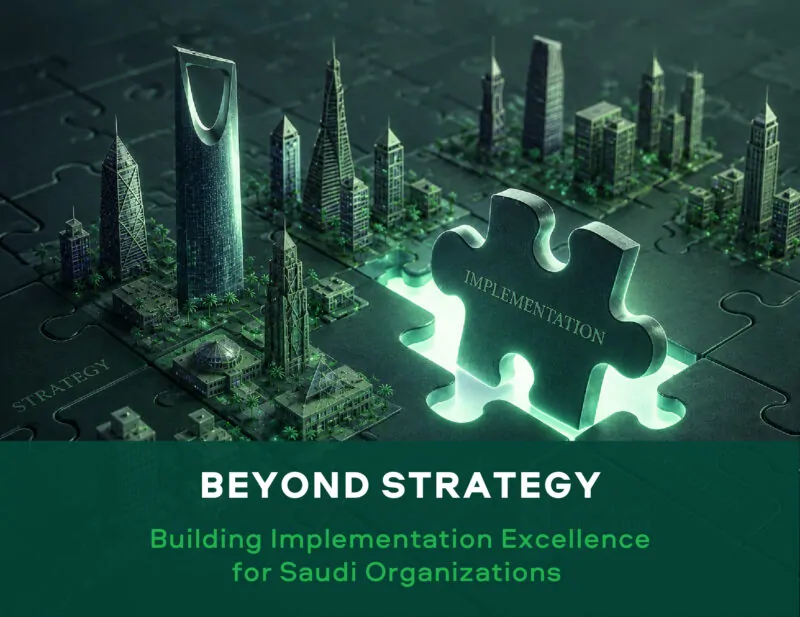
Beyond Strategy | Building Implementation Excellence for Saudi Organizations
Saudi Arabia’s transformation journey has created an environment where strategic clarity is no longer the primary challenge. Through Vision 2030, the Kingdom has established a clear national direction for economic diversification, competitiveness, public-sector modernization, private-sector growth, human capital development, and digital transformation.
Vision 2030 has provided a national direction for: competitiveness, economic diversification, public service improvement, private-sector growth, human capability development, and digital transformation.
While organizations across the Kingdom have translated this broader direction into: corporate strategies, sector plans, transformation programs, localization agendas, operating targets, and digital roadmaps.
As a result, many organizations already know where they need to go.
The more pressing question is whether they have the implementation capabilities required to get there.
As Saudi Arabia enters the final phase of Vision 2030 and simultaneously prepares for major milestones such as Expo 2030 Riyadh and the FIFA World Cup 2034, the national focus is increasingly shifting from strategy formulation to delivery excellence. The conversation is no
longer centered on defining ambitions, but on accelerating execution, maximizing impact, and
ensuring that transformation outcomes are sustainable over the long term.
For organizations, the value of strategy will increasingly be judged by its ability to influence day-to-day operations, resource allocation, workflow design, leadership behaviour, performance management, and measurable outcomes. Yet globally, execution remains one of the most persistent organizational challenges. Globally, 67% of well-formulated strategies are estimated to fail because of poor execution1, showing that the gap often appears after direction has been agreed. In practice, this gap usually sits between the strategic document and the operating reality: unclear responsibilities, inconsistent processes, disconnected digital systems, and governance that tracks activity without resolving delivery barriers.
For Saudi organizations operating in an increasingly competitive and rapidly evolving environment, the next source of advantage will not come from strategy alone. It will come from the ability to translate strategic direction into operational discipline.
1. Operational Standardization: Turning Strategic Direction into Consistent Performance
A. From Strategic Intent to Operating Model
Implementation begins when strategic priorities are translated into an operating model that defines how work should be delivered across the organization. This includes:
- Accountabilities and Decision Rights
- Approval Pathways
- Handover Points
- Performance Indicators
- Reporting Lines
- Escalation Paths
- Interfaces between Departments or Business Units
While strategy defines what an organization aims to achieve, the operating model determines how those objectives are translated into day-to-day execution. It provides the structure through which decisions are made, resources are allocated, performance is managed, and accountability is maintained.
As organizations expand in response to Vision 2030 opportunities, many are managing larger portfolios, wider geographic footprints, and more diverse stakeholder groups. Without this layer, strategy remains vulnerable to individual interpretation, and execution becomes inconsistent across teams, branches, regions, or functions.
B. Closing the Gap Between Designed Processes and Operational Reality
One of the most common implementation challenges arises when the processes designed by leadership differ from the way work is actually performed on the ground.
The designed process assumes:
- Clear ownership
- Smooth approvals
- Accurate data
- Consistent use of systems
- Defined escalation routes
Operational reality may include:
- Duplicated activities across teams
- Unclear decision-making authority
- Manual workarounds and data gaps
- Multiple disconnected tools
- Informal problem-solving echanisms
Operational standardization therefore requires organizations to move closer to delivery reality. Process mapping, operational audits, role clarification, workflow diagnostics, and bottleneck analysis help reveal whether the designed model is being applied as intended, where execution is slowed, where accountability is diluted, and where the model needs adjustment.
C. Protecting Financial and Operational Health
When decision rights, workflows, and accountability structures are unclear, execution often becomes costly and difficult to control. Organizations may experience:
- Duplicated effort
- Delayed approvals
- Weak ownership of cost drivers
- Inconsistent procurement practices
- Limited visibility over how resources are being used
This is particularly important in sectors supporting Vision 2030, where organizations are expected to deliver ambitious growth while maintaining efficiency, governance, and financial discipline. As Saudi organizations scale across regions, programs, and partnerships, the ability to grow without losing operational control becomes a central implementation capability.