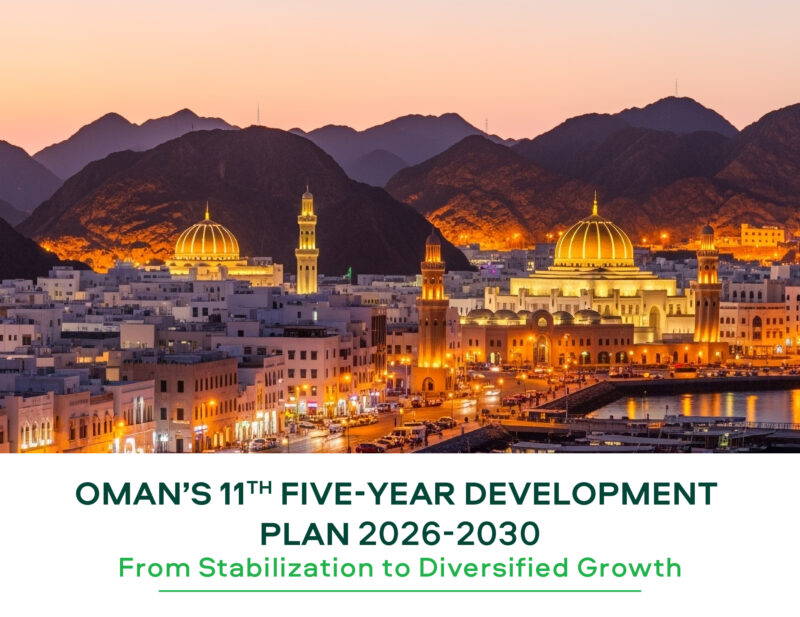
Oman’s 11th Five-Year Development Plan 2026–2030
From Stabilization to Diversified Growth
Oman’s 11th Five-Year Development Plan 2026–2030 marks a new implementation phase in the country’s long-term development journey, serving as the second executive roadmap under Oman Vision 2040 after the 10th Five-Year Plan, which covered the 2021–2025 period. The plan was formally adopted through Royal Decree 1/2026, which approved the plan’s objectives and required its implementation in line with the approved economic and financial framework.
The 10th Five-Year Plan was largely focused on restoring economic stability, addressing fiscal pressures, and supporting recovery after a period shaped by oil price volatility and the pandemic’s economic effects.
Oman’s Ministry of Foreign Affairs describes the 11th Plan as a bridge from economic recovery toward a phase of growth and expansion.
Supported by clearer legislative and regulatory frameworks. This makes the new plan less of a standalone policy document and more of a continuation of Oman’s effort to convert Vision 2040 into measurable economic and institutional outcomes.
The plan also builds on the reported achievements of the previous planning cycle. According to the Ministry of Foreign Affairs, Oman’s 10th Five-Year Plan achieved a 97% implementation rate1 , with 398 out of 411 strategic programs completed, giving the government a stronger base from which to move into the 2026–2030 cycle. This creates a different strategic context for the 11th Plan. The priority is no longer only to stabilize the economy, but to:
- Accelerate diversification
- Deepen private-sector participation
- Improve employment outcomes
- Strengthen the country’s capacity to sustain growth beyond oil
At the heart of the plan is a dual objective: maintaining fiscal discipline while expanding the engines of non-oil growth. The plan targets real GDP growth while emphasizing economic diversification, fiscal sustainability, competitiveness, and the gradual transition toward a low-carbon economy. It also identifies manufacturing, tourism, and the digital economy as core growth sectors, supported by enabling sectors such as mining, food security, renewable energy, transport and logistics, education, and health.
This gives the 11th Plan a practical significance beyond macroeconomic planning. It sets the direction for where investment is expected to flow, which sectors are expected to generate growth, how employment opportunities will be created for Omanis, and how the government intends to monitor implementation.
I. THE STRUCTURE OF THE PLAN
A Phased Roadmap Linked to Vision 2040
The 11th Five-Year Development Plan is structured as a phased roadmap. Its implementation timeline is divided into three stages:
- Work Program covering 2026–2027
- Work Program covering 2028–2029
- Work Program in 2030 dedicated to evaluation and preparation for the 12th Five-Year Plan
This phased structure gives the plan a more adaptive implementation logic, allowing Oman to review progress, recalibrate priorities, and prepare the next development cycle based on actual performance. The plan is also organized around two main pathways:
- Economic Pathway: Designed to support sustainable diversification, strengthen national export capacity, address economic challenges, and generate employment opportunities.
- Developmental Pathway: Focuses on infrastructure, wider development needs, balanced social and environmental progress, and the improvement of household income in line with Oman Vision 2040.
This dual-pathway structure shows that Oman is not treating economic diversification as a purely sectoral agenda. Instead, the plan links growth with broader development outcomes, including infrastructure, social progress, environmental sustainability, and household welfare.
The plan is further translated into:
- 190 Strategic Programs spanning
- 12 National priorities
- 4 Pillars
These programs were issued by the Ministry of Economy as a Strategic Programs Volume for the 11th Plan, providing a detailed roadmap for implementing national priorities under Oman Vision 2040.
The strategic programs are designed to function as a central reference for government entities and stakeholders. It sets out program objectives, implementation mechanisms, timelines, and the roles of executing and supporting entities, while aiming to strengthen planning efficiency, coordination, and clarity in delivering development outcomes. Each program is also linked to performance indicators to support monitoring, evaluation, and continuous improvement.